
Separate alignment from centering
The outer physical corners straighten the photograph. Printed borders measure how the design sits within the card. Aligning the photograph does not automatically measure centering. In CardGrader, open Measure Centering after alignment and verify every printed-border guide.
Example from CardGrader
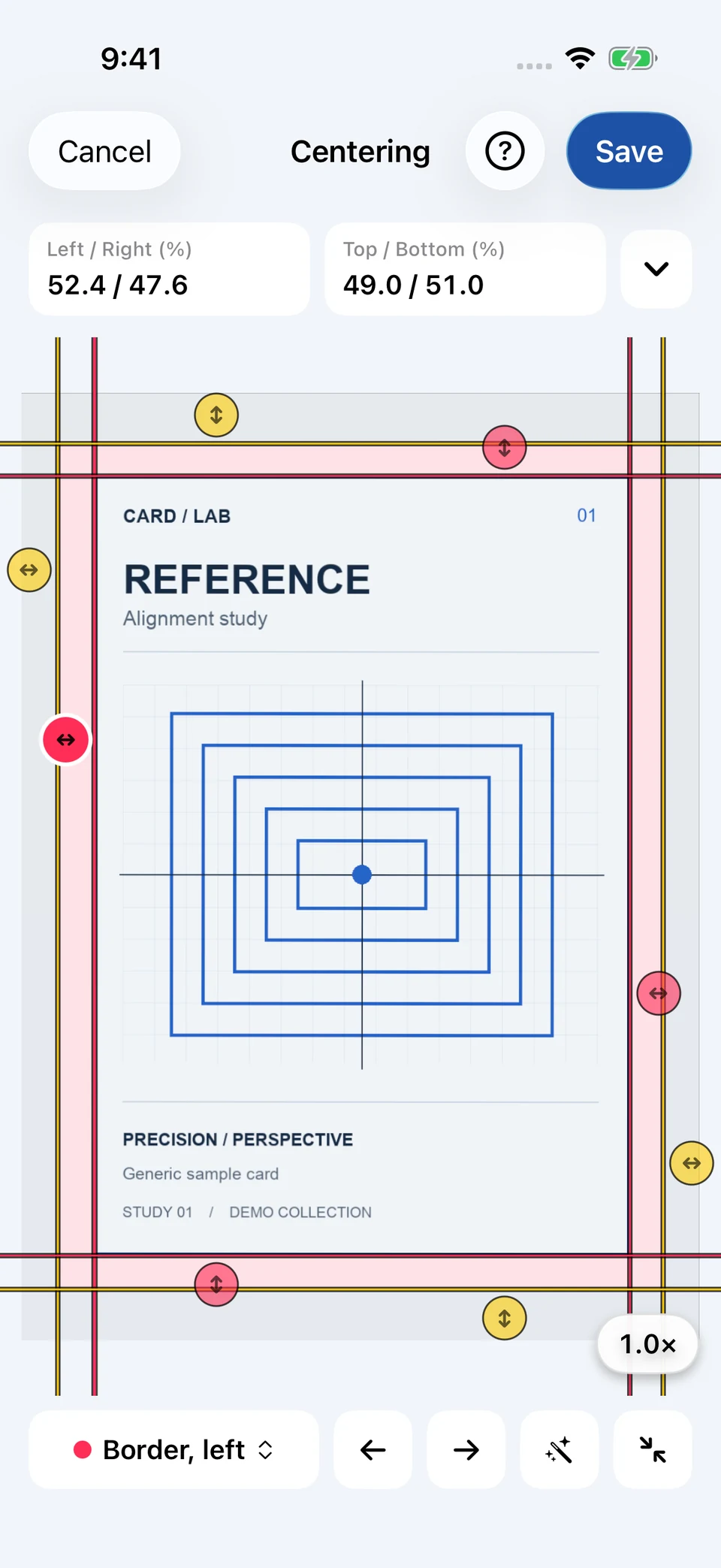
This reference-card capture reads 52.4/47.6 left/right and 49.0/51.0 top/bottom. Move the guides to change the measurement; these sample readings are not a certified grade or an accuracy test.
Actual app capture · original demo artwork
See the full app walkthrough →Genuine iPhone simulator capture. The geometric reference card is original demo artwork. The screenshot illustrates the controls, not performance on real card photographs.
Calculate the border ratios
For an ordinary rectangular printed border, measure the left border L and right border R in the same units. Left percentage = 100 × L / (L + R); right percentage = 100 × R / (L + R). Repeat with top T and bottom B. A left border of 3 units and right border of 2 units gives 60/40, while equal borders give 50/50. A zero combined width is not a valid measurement.
Refine the guides and inspect each side
Pinch to zoom while placing guides; CardGrader displays the current zoom level. Check front and back separately. Keep border measurements distinct from corner wear. Full-art, borderless, ambiguous, and unusual layouts may not have a meaningful ordinary printed-border ratio. For e-reader stripe layouts, verify the suggested layout and use the app’s layout-aware paired guides; do not apply the ordinary-border example blindly.
Interpret comparisons cautiously
CardGrader compares measurements with published PSA, BGS, CGC, and TAG tolerances. A centering comparison describes one aspect of a card and does not promise a professional grade. Completed manual corner and edge scores may lower the provisional estimate using an app-defined rule. Surface and unscanned sides remain unassessed. CardGrader is independent of these grading services.